Research
Job Market Paper
Working Papers
The Effect of Unemployment Benefit Supplements: Evidence from the Lost Wages Assistance Program
Revise and Resubmit, Journal of Public Economics
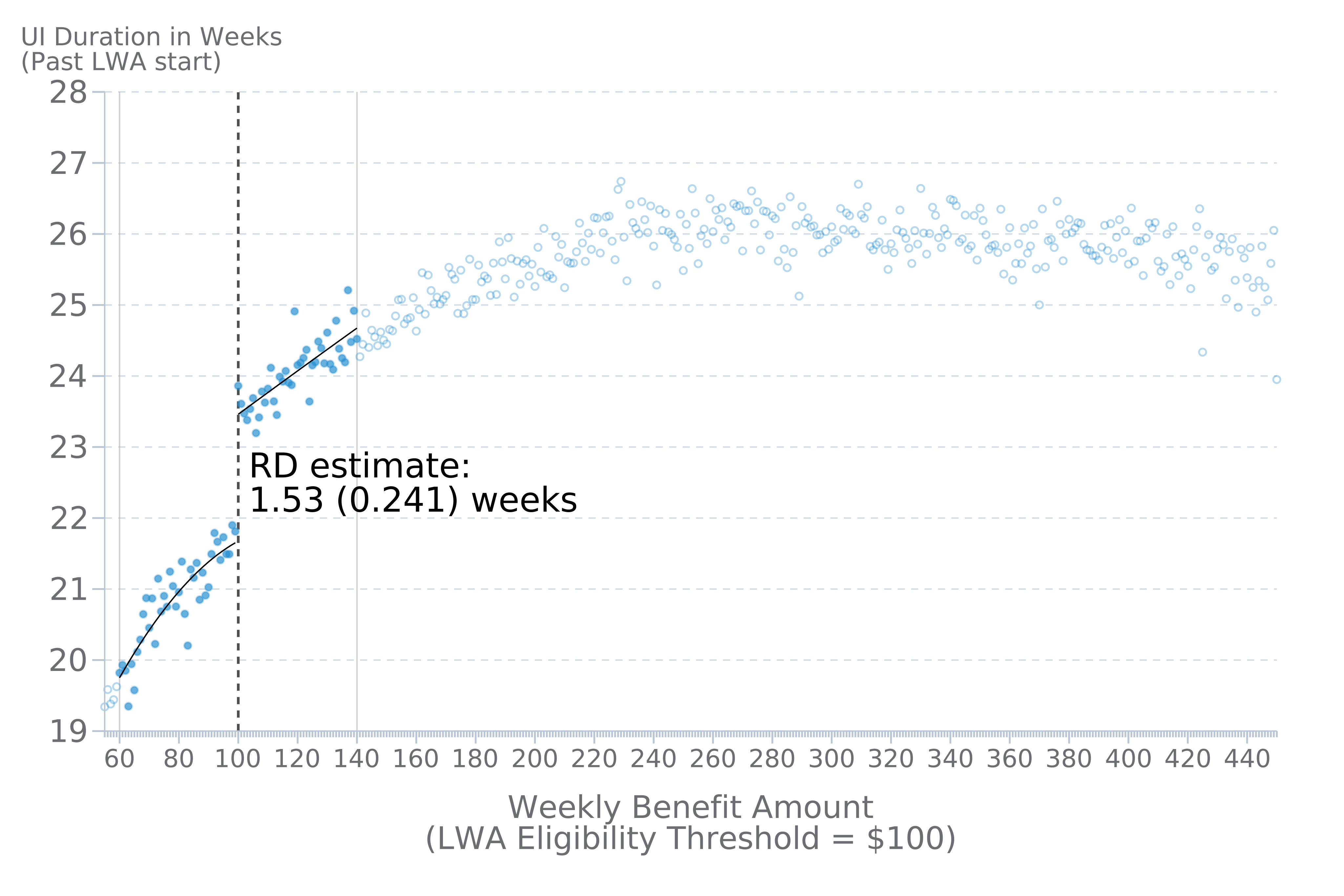
This article studies the effects of large, temporary unemployment insurance supplements. Using administrative data from California, I implement a regression discontinuity design around an eligibility threshold for the Lost Wages Assistance Program, a 2020 program providing 6 weeks of $300/week supplements to claimants with weekly benefit amounts over $100. The supplements had a minimal effect on labor supply, increasing unemployment durations by just 1.5 weeks. This response was mostly driven by liquidity effects rather than distorting incentives, suggesting the supplements were welfare-enhancing. The supplements did not affect job quality and had a limited effect on the state's unemployment rate.
@unpublished{hedin2025supplements,
  title  = {The Effect of Unemployment Benefit Supplements: Evidence from
            the Lost Wages Assistance Program},
  author = {Hedin, TJ},
  year   = {2025},
  note   = {Revise and Resubmit, Journal of Public Economics}
}
Publications
UI Benefit Generosity and Labor Supply from 2002–2020: Evidence from California UI Records
Journal of Labor Economics, 2024
NBER Working Paper No. 32071, 2024
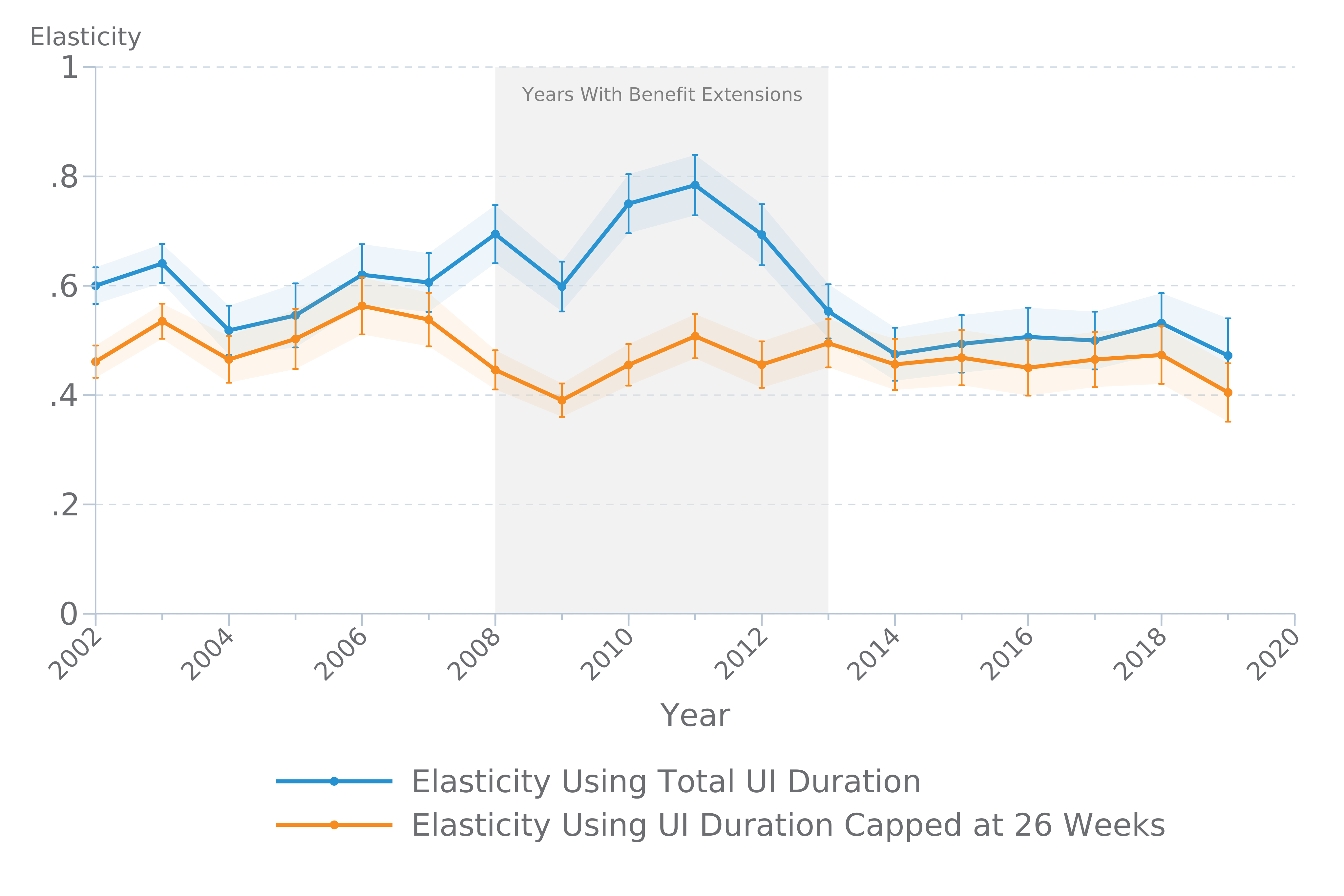
This paper obtains comparable estimates of the effect of unemployment insurance (UI) benefits on labor supply throughout the unemployment spell and over the business cycle using a regression kink design and 20 years of administrative data from California. For a given unemployment duration, the behavioral effect of UI benefit levels on labor supply does not vary with the business cycle from 2002 to 2019. However, due to increased coverage from extensions in benefit durations, the duration elasticity of UI benefits rises during recessions. The behavioral effect during the start of the COVID-19 pandemic is substantially lower at all unemployment durations.
@article{bell2024ui,
  title   = {Unemployment Insurance (UI) Benefit Generosity and Labor Supply
             from 2002 to 2020: Evidence from California UI Records},
  author  = {Bell, Alex and Hedin, TJ and Schnorr, Geoffrey and
             von Wachter, Till},
  journal = {Journal of Labor Economics},
  volume  = {42},
  number  = {S1},
  pages   = {S379--S416},
  year    = {2024},
  doi     = {10.1086/728808}
}
Estimating the Disparate Cumulative Impact of the Pandemic in Administrative Unemployment Insurance Data
AEA Papers & Proceedings, 2022
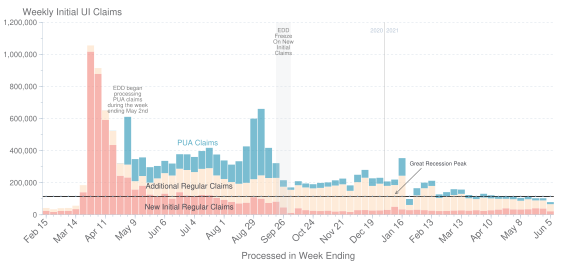
To better measure the full extent of the impact of the COVID-19 crisis on workers and the labor market, this paper estimates three measures of the cumulative impact of the pandemic on workers across intensive and extensive margins using longitudinal administrative unemployment insurance (UI) data from California. During the first year of the crisis, 30 percent of the labor force filed a UI claim, over 50 percent of recipients spent more than 6 months on the program, and the mean work time lost was 13 weeks. Less advantaged workers and counties saw much higher rates of claiming and long-term unemployment.
@article{bell2022disparate,
  title   = {Estimating the Disparate Cumulative Impact of the Pandemic in
             Administrative Unemployment Insurance Data},
  author  = {Bell, Alex and Hedin, TJ and Mannino, Peter and
             Moghadam, Roozbeh and Romer, Carl and Schnorr, Geoffrey C. and
             von Wachter, Till},
  journal = {AEA Papers and Proceedings},
  volume  = {112},
  pages   = {78--84},
  year    = {2022},
  doi     = {10.1257/pandp.20221008}
}
Disparities in Access to Unemployment Insurance During the COVID-19 Pandemic: Lessons from U.S. and California Claims Data
RSF: The Russell Sage Foundation Journal of the Social Sciences, 2023
Report to the U.S. Department of Labor, 2022
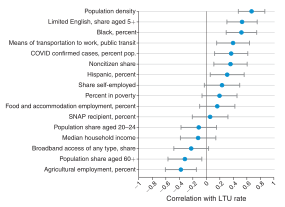
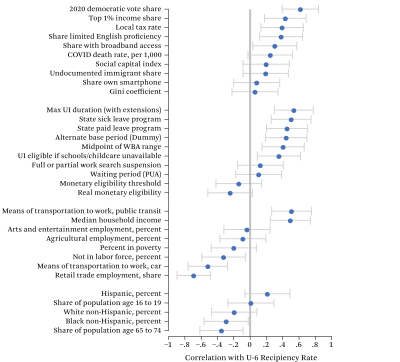
To what extent did jobless Americans benefit from unemployment insurance (UI) during the COVID-19 pandemic? This article documents geographic disparities in access to UI during 2020. We leverage aggregated and individual-level claims data to perform an integrated analysis across four measures of access to UI. In addition to the traditional UI recipiency rate, we construct rates of application among the unemployed, rates of first payment among applicants, and exhaustion rates among paid claimants. Through correlations across California counties and across states, we show that areas with more disadvantaged residents had less access to UI during the pandemic. Although these disparities are large in magnitude, cross-state analysis suggests that policy can play a salient role in mitigating them.
@article{bell2023disparities,
  title   = {Disparities in Access to Unemployment Insurance During the
             COVID-19 Pandemic: Lessons from U.S. and California Claims Data},
  author  = {Bell, Alex and Hedin, TJ and Mannino, Peter and
             Moghadam, Roozbeh and Schnorr, Geoffrey and von Wachter, Till},
  journal = {RSF: The Russell Sage Foundation Journal of the Social Sciences},
  volume  = {9},
  number  = {3},
  pages   = {78--109},
  year    = {2023},
  doi     = {10.7758/RSF.2023.9.3.04}
}
Work in Progress
Can Ignition Interlock Devices Reduce Drunk Driving Recidivism? Evidence from California
Unemployment Benefit Generosity on Future Job Quality
Policy Reports
An Evaluation of an Expansion of the Use of Ignition Interlock Devices through California Senate Bill 1046
Report to the California State Transportation Agency
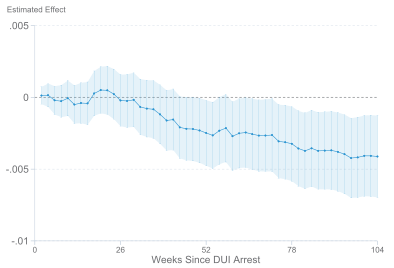
California Senate Bill (SB) 1046 mandates that starting January 1, 2019, all persons convicted of a repeat driving-under-the-influence (DUI) offense as well as all persons convicted of an injury-involved DUI install an Ignition Interlock Device (IID) for a time period ranging from 12 to 48 months. The legislation also makes it possible for people to install an IID to avoid the preconviction revocation that typically occurs thirty days after an alcohol-impaired driving arrest. This report documents changes in IID installations and estimates the effects of IIDs on driving behavior and DUI recidivism outcomes before and after the implementation of SB 1046.
Analysis of Unemployment Insurance Claims in California During the COVID-19 Pandemic
California Policy Lab, series of reports
A series of monthly research reports analyzing individual-level administrative UI data from California during the COVID-19 pandemic. The reports take a longitudinal approach — tracking entry, continued receipt, and exit — to measure the scale and persistence of UI reliance, including repeated claims and cumulative benefit exposure, and quantify the effects of policy changes such as the expiration of emergency federal programs on workers receiving UI and on benefit payment flows. The series informed policy decisions on emergency extensions and UI system design.